Video protection: your cameras know more than you think
A local authority can already use its video protection cameras to better understand its territory: counting pedestrians, bikes or cars, measuring how busy a square is, spotting wrong-way drivers. That is one of the key messages of the white paper “Video protection for elected officials and future elected officials” (in French) published by AN2V, the French National Video Protection Association. Alyce, a member of the association, contributed to this collective work. Here are the key takeaways.
Reading time: 5 min
What can a camera do beyond security?
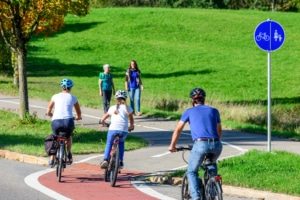
A video protection camera is also a mobility sensor. It can count pedestrians on a shopping street, bikes on a cycle lane or cars at a junction, measure congestion or check that new infrastructure is actually being used. A camera network then becomes an observatory of the territory, useful for assessing a mobility policy or preparing a mobility plan.
The topic has matured: according to a study quoted in the white paper, 94.5% of French elected officials and local government managers support automated image analysis for practical uses.
What is the difference between R2A and R2D?
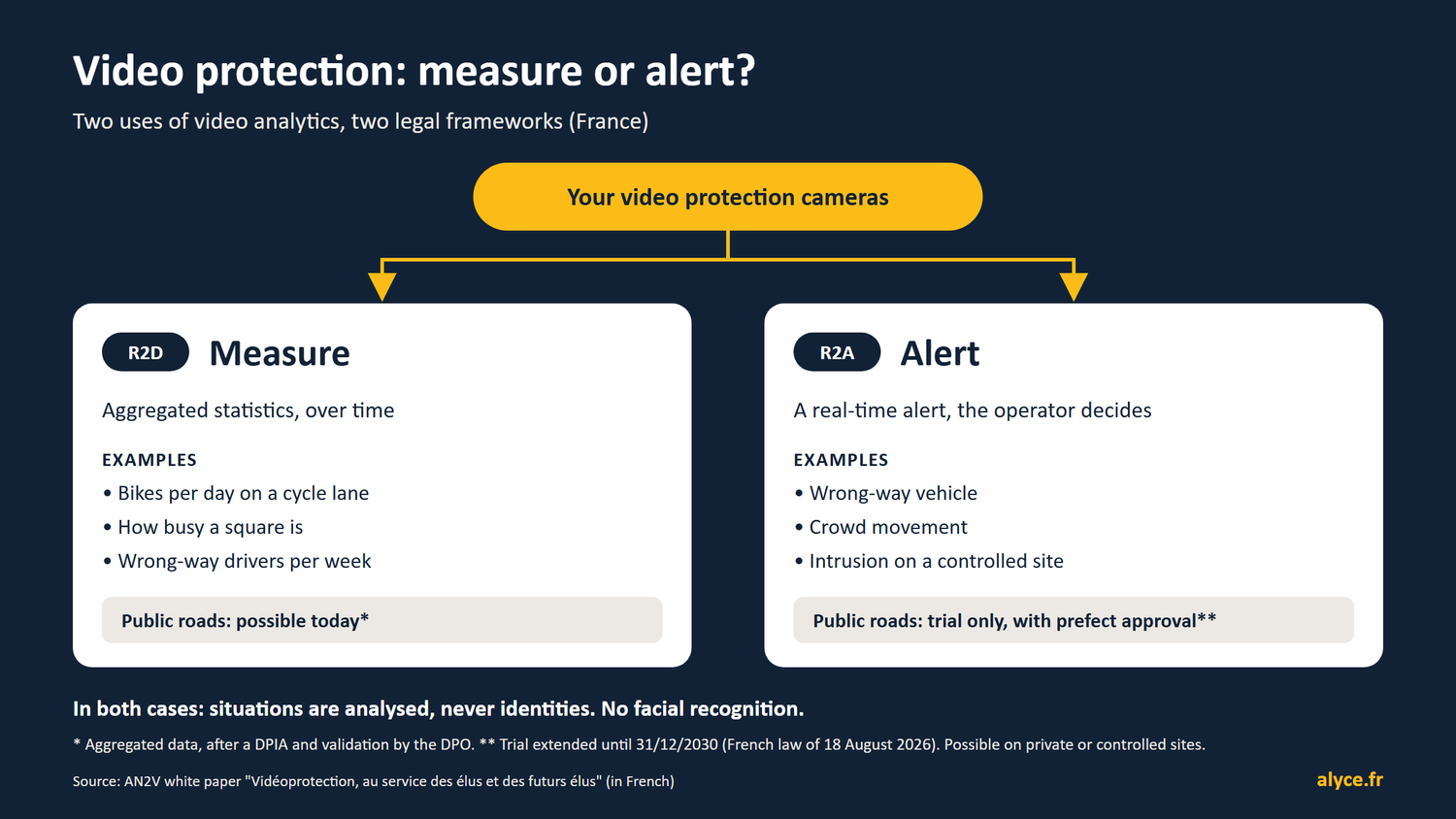
The white paper distinguishes two approaches. R2D (automatic data reporting) produces aggregated statistics. R2A (automatic alert reporting) flags a situation in real time to an operator, who decides what to do next. In both cases, situations are analysed, never identities.
| R2D: measure | R2A: alert | |
|---|---|---|
| Output | Aggregated statistics | An alert sent to an operator |
| Timeframe | Over time | Real time |
| Examples | Bikes per day, how busy a square is, wrong-way drivers per week | Wrong-way vehicle, crowd movement |
| On public roads | Possible today | Trial until 31/12/2030, with prefect authorisation |
| On private or controlled sites | Possible | Possible, with clear governance |
What is allowed today in France?
Measuring: yes. Statistical uses are possible right now, provided the data is aggregated and non-intrusive, and validated by the local authority’s Data Protection Officer (DPO) after a Data Protection Impact Assessment (DPIA).
Alerting on public roads: only on a trial basis. Automatic alerts are still not authorised under ordinary law. The trial launched for the Paris 2024 Olympic Games has been extended until 31 December 2030 by the law of 18 August 2026, and widened to certain particularly exposed places open to the public. It still requires authorisation from the prefect, limited in time and to predefined situations. AN2V’s advice still applies: get ready, without deploying anything outside this framework.
The foundations remain the same: authorisation by the prefect, purposes set out in article L251-2 of the French Internal Security Code, public information and image retention limited to one month, as the CNIL, France’s data protection authority, points out. The EU AI Act also prohibits real-time facial recognition for general identification purposes in public spaces.
Where to start?
- What do you want to measure? A flow, a use, a footfall level.
- Where? Public road, building open to the public or private site: the rules differ.
- Is it compliant? DPIA, retention periods, public information.
- Who uses the data? And to inform which decision?
- How will you report on it? To elected officials, the municipal council, residents.
What can minUi® do?
minUi®, Alyce’s video analytics software, turns footage from your existing cameras into mobility data, in real time or after the fact. It is compatible with Genetec and Milestone and works without facial recognition.
To measure
- counts by mode: cars, vans, HGVs, buses, two-wheelers, bikes, pedestrians, e-scooters
- speeds, trajectories, occupancy rates, parking availability
- footfall and crowd counting
- wrong-way driving, obstructive parking, vehicles on cycle lanes (see our article on road safety)
To alert
- wrong-way vehicles and traffic incidents
- crowd movements
- obstructive parking
- intrusions and abandoned luggage
Want to know what your cameras could tell you? Let’s talk.
Frequently asked questions
Can video protection cameras be used to count bikes or pedestrians?
Yes. According to the AN2V white paper, counting is a data reporting use (R2D) that is possible today in France, including on public roads, as long as the data remains aggregated, contains no biometric data, and the project is validated by the local authority’s DPO.
What is a DPIA?
A DPIA, or Data Protection Impact Assessment, is a study carried out before a project is launched. It assesses the risks to the privacy of the people filmed and sets out measures to reduce them. Article 35 of the GDPR makes it mandatory in particular for large-scale monitoring of a publicly accessible area. The French data protection authority, the CNIL, provides a guide and a free tool to carry one out.
Can we receive wrong-way driving alerts on public roads?
Not freely. As of November 2026, automatic alerts in public spaces in France remain a trial, extended until 31 December 2030: they are only possible with authorisation from the prefect, for defined places and situations. They are possible on private or controlled sites. Measuring wrong-way driving statistically, however, is allowed.
Does minUi® use facial recognition?
No. minUi® analyses flows and situations (vehicles, pedestrians, bikes, occupancy of a space), never people’s identities. This is also the principle set out in the white paper: detect situations, not identities.
How long can video protection footage be kept?
In France, a maximum of one month for cameras filming public roads, according to the CNIL. Statistical data produced by the analysis has its own retention period, to be defined in the DPIA.
Do I need specific cameras to use minUi®?
No. minUi® can use the video streams from cameras that are already installed, and is compatible with Genetec and Milestone.
Sources
- AN2V, white paper “Video protection for elected officials and future elected officials” (in French)
- CNIL, La vidéoprotection (in French, updated 9 March 2026)
- CNIL, Data Protection Impact Assessment (DPIA) (in French)
- General Data Protection Regulation (GDPR), article 35
- French Constitutional Council, decision no. 2026-915 DC of 14 August 2026 (law of 18 August 2026, article 50, in French)
- French Internal Security Code, article L251-2 (in French)
- Regulation (EU) 2024/1689 on artificial intelligence (AI Act)